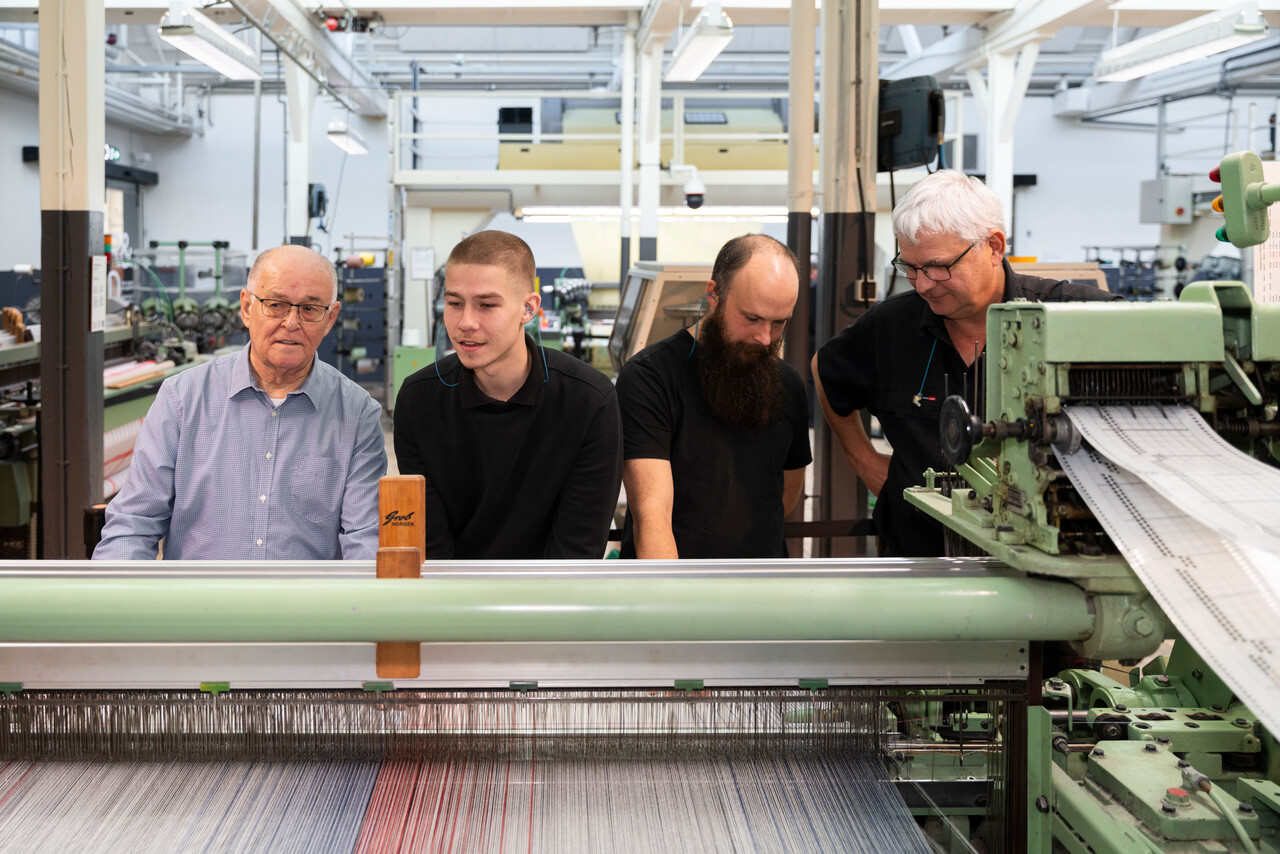
Paul teaches Jim and Marijn how they should listen to the loom
30 June 2026
In Tilburg, once the beating heart of the Dutch textile industry, the craft of weaving is being brought back to life. Through its own master-apprentice programme, TextielLab is training a new generation of craftspeople.
“TextielMuseum is looking for bicycle mechanics.” With this striking job advertisement, TextielLab set out to find new craftspeople: people with good practical skills, technical insight and, above all, a real desire to learn a craft. Previous experience in textiles was not required. Curiosity and commitment were what mattered. After all, there is no longer a formal training programme for weavers in the Netherlands, and the number of weaving mills can be counted on one hand. The craft of weaving is at risk of disappearing. That is why TextielLab set up its own master-apprentice programme: to train new talent and preserve this knowledge for the future.
The new generation: Jim and Marijn
Jim Rollé and Marijn Verstappen both responded to the call for ‘bicycle mechanics’. Jim loves his work at TextielMuseum and TextielLab. He moves through the lab and museum as though he has worked there all his life. Greeting colleagues. Making jokes. Although he had never worked in a technical profession before, he enjoys his work. “You shouldn’t try to understand everything straight away; it’s a matter of doing. Besides, it’s mechanics – you start to see the logic for yourself.”

From left to right: Jim Rollé, Michel Leermakers, Marijn Verstappen and Paul Looijkens. Photo by Patty van den Elshout.
If you had asked him a few years ago, Jim would never have imagined that he would end up working with textiles. After four years in a tapas restaurant kitchen and five years as a maintenance painter, he felt it was time for something different. “In my spare time, I enjoyed being creative and tufting rugs,” he says. “My mother thought this might be something for me. Adjusting the warp stop motions. Reweaving. Keeping the warp beam under tension. Tinkering with things… This is where I’m learning the craft.”

Photo by Patty van den Elshout
Marijn, too, never expected to end up at a knowledge institute such as TextielLab. “I’m someone who has had twelve trades and thirteen accidents,” he jokes. Marijn has worked as a sound engineer, installed solar panels and worked with components for the oil industry. Now he has found his place and helps designers turn their ideas into reality. “The machines, working with the product developers, the technical side of things – I love the variety. At TextielLab, I can keep learning and keep developing.”
The master: Paul Looijkens
You could safely call Paul Looijkens a textile veteran. This sprightly octogenarian started working in a textile factory at the age of fourteen. Tying knots, weaving samples, setting up looms – he did it all. Paul is a wealth of knowledge and stories. Above all, he is a craftsman. When he stands behind the 1930 Buckskin loom, his hands move precisely across the machine, almost as if he were playing the piano. He knows exactly – and we mean exactly – how the Buckskin and many of the other weaving machines in the museum work. Paul is one of the masters teaching Jim and Marijn the craft. Every Thursday, he can be found at the museum: explaining, demonstrating, working together and sharing stories from the past.

Paul Looijkens, Photo by Patty van den Elshout
One-point lessons and preserving knowledge
An important part of the master-apprentice programme is the restoration and maintenance of old looms. Technical specialist Michel Leermakers works on projects within TextielLab and helps ensure that knowledge is preserved. Under Paul’s guidance, Michel is working with Jim and Marijn to restore the Jacquard loom, dating from 1925. “Paul shares his knowledge and shows us how to operate and maintain the machine. To capture that knowledge and Paul’s way of working efficiently, we create one-point lessons,” he explains. “These are concise instructions that clearly explain one specific task, using photographs, videos and short texts. With an OPL, someone with technical knowledge can see exactly what they need to do.”
Together, all these one-point lessons about the Jacquard loom form a valuable document in their own right, permanently recording knowledge about how to operate and maintain the machine.

Michel Leermakers, Photo by Patty van den Elshout
There are currently very few people in the Netherlands who know more about how weaving looms work than Marijn and Jim. “What makes this project special is that the lab and museum genuinely give us the time and space to do it properly,” says Marijn.
“Paper instructions alone are not enough,” Paul emphasises. “You can’t draw or write everything down. It’s also important to run the machine and work with it. A weaver needs to see, hear and feel. Sometimes you can simply hear that something isn’t right. Your machine tells you what is going wrong, if you listen carefully.”
Look, think, then act
Paul himself learned the craft from specialists in the textile factories where he worked. He is pleased to be able to pass the craft on in this way. “It’s important that this knowledge is not lost. If we don’t document it, no one will know how these machines worked in the future. I can see that these men are genuinely interested, and that makes me happy.”
Technical specialist Michel is still learning from Paul, too. “Look, think and only then act. That’s what Paul teaches us.”

Gerard Kuijpers, Photo by Patty van den Elshout
When can the master-apprentice programme be considered a success? Gerard Kuijpers is Manager of Technical Operations at TextielLab. “This craft is an important part of our industrial heritage, and we need to continue investing in it,” he says. “If, one day, no one knows how to weave anymore, it will be gone. Forever. This project will be a success if, in a few years’ time, these two men are still working here with pleasure, maintaining and operating the looms, sharing the stories and keeping the craft alive.”