Transcriptie:
Je staat hier bij de Project Space. Hier zijn steeds verschillende presentaties met eindproducten te zien. In deze aflevering horen we wat er uitgekomen is bij Elmo Mistiaen en Otobong Nkanga. Hun kunstwerken zie je niet in deze ruimte, maar wel op je telefoonscherm. Laten we eerst eens luisteren naar Elmo Mistaen.
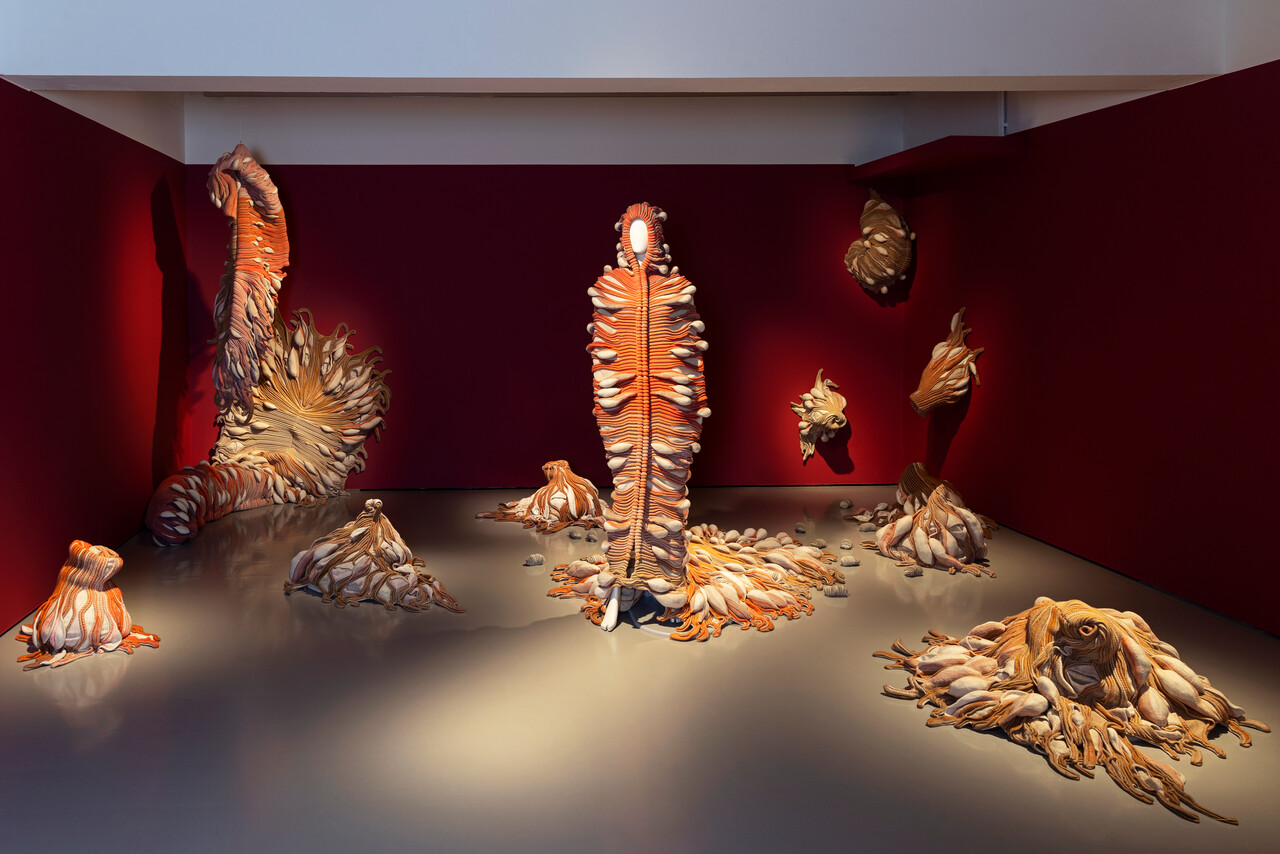
Het werk is uiteindelijk een soort van kleed met een kap geworden met vreemde organische structuren. Een soort van, het lijkt een organisme, een soort creature dat op zich leeft. Maar het heeft de mens nodig om voedingsstoffen te nemen en verder te groeien.
Conservator Danique Klijs vertelt waarom het werk van Elmo zo goed past bij het museum.
"Het werk van Elmo is op meerdere niveaus super interessant. In de eerste plaats op technisch niveau. Daarnaast is het ook een heel mooi voorbeeld geworden van sculpturale mode. Een uniek onderdeel van onze collectie. Dus mode die zich echt op het snijvlak van kunst bevindt. Daar is het ook weer een heel mooie toevoeging aan. En tenslotte zit het conceptueel supersterk in elkaar."
Elmo's werk is dus een bijzondere toevoeging aan de collectie van het museum. Maar niet elk werk dat hier ontstaat, blijft ook hier. Sommige werken reizen de wereld over. Zoals het werk Cadence, van Otobong Nkanga, dat speciaal gemaakt werd voor het atrium van het Museum of Modern Art in New York. Een monumentaal wandkleed van 20 meter hoog, 11 meter breed en vier lagen dik. In dit werk gaat het over de afbraak van het leven én wat er kan voortkomen uit deze ravage.
Je hoorde kunstenaar Otobong Nkanga over haar werk. Maar wat betekent zo’n imposant werk voor de collectie van het museum?
Wij laten slechts een stukje zien van wat er wordt gemaakt in het lab. Maar het is heel fijn dat een groot deel van de werken de hele wereld over reizen en dus op zulke bijzondere plekken uitkomen als het MoMA in New York.
Twee kunstenaars, twee uitkomsten. Allebei een resultaat van de samenwerking tussen maker en specialist, tussen visie en vakmanschap. Maar het TextielLab is niet alleen een platform voor gerenommeerde kunstenaars. Het is ook een kweekvijver. Een plek waar jong talent leert, experimenteert, en groeit. En een plek waar naast de allernieuwste technieken en machines ook het oude erfgoed, de oorspronkelijke machines, worden gerevitaliseerd. Hoe het TextielLab de toekomst van textiel vormgeeft? Dat hoor je in de volgende aflevering. Je vindt de QR-code bij het bordje over Passementen, ga hiervoor de deur door bij de Spoelmachine.
English transcription:
This is the Project Space, where final works are regularly displayed.
You won’t see the artworks discussed here, but you can view them on your phone.
Let’s start with Elmo Mistiaen.
“The final piece became a kind of hooded garment with strange organic structures. It resembles an organism that is self-sustaining, but it needs humans to absorb nutrients and continue to grow.”
Curator Danique Klijs explains why the work is such a good fit for the museum.
“Elmo's work is interesting on several levels. Technically, it’s remarkable. As an example of sculptural fashion – where art and fashion truly intersect – it’s a unique part of our collection. Conceptually, it’s also very strong.”
So, Elmo's work is a special addition to the museum's collection. But not every work created here stays here. Some works travel the world.
Like Cadence, by Otobong Nkanga, which was specially created for the atrium of the Museum of Modern Art in New York. Measuring 20 metres high, 11 metres wide and 4 layers thick, this monumental tapestry explores the degradation of the natural world and what can emerge from this devastation.
“So, Cadence is a work that is looking at the notion of decay into something that blossoms, gives lives with fungus and fungi, into the sense of impossibility, looking at the world in its state of decay and debris”
That was artist Otobong Nkanga talking about her work. But what does such an impressive work mean for the museum's collection?
We show only a small part of what is created in the lab. But it's wonderful that many of the works travel the world and end up in such remarkable places as MoMA in New York.
Two artists, two outcomes. Both a result of collaboration between maker and specialist, between vision and craftsmanship.
But the TextielLab isn't just a platform for renowned artists. It's also a place where the next generation can learn, experiment and grow. And it’s a place where, alongside the latest techniques and machines, heritage and technical history are revitalised.
How is the TextielLab shaping the future of textiles?
Find out in the next episode. The QR code is near the Passementerie sign. Go through the door next to the bobbin machine to find it.